

Why engineering teams struggle without a staff augmentation team
Traditional hiring in the software sector has functionally collapsed. Engineering leaders today are already familiar with this cycle:
- You open a requisition for a senior architect, and the role stays unfilled for months.
- Countless hours are spent interviewing generic, unvetted applicants.
- The product roadmap slips week by painful week.
This is not a hiring issue. It is a delivery bottleneck.
Teams facing this bottleneck start looking for faster ways to scale engineering capacity.
The standard process of sourcing and onboarding local talent is simply too slow for current market realities. We are expected to ship complex features in weeks, not quarters. This brutal disconnect between delivery expectations and local talent availability is exactly why technical leaders are abandoning traditional recruitment to solve immediate capacity issues.
Instead, they are pivoting to staff augmentation services to bypass the bottleneck entirely. As an innovative solutions integrator and custom software development company, Program-Ace delivers full-cycle custom software development, ensuring smooth integration of each solution into your business processes and goals. Through our Staff Augmentation model, we smoothly integrate vetted developers and teams into your projects, with our Talent Ace methodology ensuring the right match and smooth onboarding.
This guide breaks down the unvarnished reality of the 2026 talent market and the exact operational mechanics required to scale successfully. Use these insights to reassess your engineering capacity strategy – take decisive steps today to future-proof your delivery.
Why building an IT staff augmentation team is essential today
We aren’t just guessing that the market has changed. The shift is clearly reflected in industry data. Global IT outsourcing has grown into a multi-hundred-billion-dollar market, with recent estimates placing it well above 250 billion US dollars. What used to be a tactical solution is now a core delivery model for engineering teams.
Post-pandemic, companies moved away from location-bound hiring and began building distributed, hybrid teams at scale. External engineers are no longer used only for overflow work. They are now integrated directly into core product development. Long-term projections point to continued growth of outsourcing and augmentation models through 2030, driven by ongoing talent shortages and increasing technical complexity.
Why is this happening at such a staggering scale?
- Widespread talent scarcity: Talent shortages have become a persistent, project-level risk for engineering teams. Many organizations struggle to find and retain specialists with the depth of expertise required for modern systems. According to Gartner research, talent availability remains one of the primary risk factors for IT leaders and continues to limit the adoption of new technologies across organizations.
- The enterprise shift: Enterprises are restructuring their workforce models to integrate internal teams with external specialists. PwC research highlights that contingent workforce strategies are increasingly embedded into standard operating structures, allowing organizations to scale capabilities and respond faster to changing delivery demands.
- Market penetration in mid-size tech: If you look at mid-size tech companies operating across North America and Europe right now, more than half of them are utilizing some form of external team integration. For a deeper look at how this impacts delivery, exploring software development outsourcing trends reveals that the push is primarily for velocity, more than cost-cutting.
- Strategic agility over cost: Companies aren’t doing this just to save a few dollars on hourly rates. They are doing it because they literally cannot find the people they need to build their products otherwise. They desperately need to cut hiring times from several months down to a matter of days.
What is staff augmentation?
Staff augmentation is a flexible outsourcing model where companies extend their internal team with external specialists who work under the same management, processes, and tools. Unlike traditional outsourcing, this approach keeps full control over development while adding the exact expertise required to move faster. Teams use it to fill critical skill gaps, accelerate delivery, and avoid long hiring cycles without committing to permanent roles. Read the full guide on what is staff augmentation and how it works.
Defining the skill deficit for your staff augmentation team
The phrase “skill gap” gets thrown around a lot in board meetings. But it doesn’t mean what it meant five years ago. We aren’t lacking junior developers who can spin up a basic front-end interface in React. We are drowning in generalists. What we actually lack is deep, hyper-specific expertise in emerging technologies.
The Global AI Jobs Barometer revealed something terrifying for technical leaders: the skills required for AI-exposed jobs are mutating far faster than standard engineering roles. The pace of that change is accelerating every single quarter.
When you decide to look outward and build an external squad, you are usually trying to solve one of three very specific, very painful technical shortages:
- The agentic AI deficit: The industry hype cycle has moved way past simple, chat-based AI wrappers. Real enterprise value right now is being built in “agentic” frameworks. These are autonomous software agents that can execute complex, multi-step logic across disparate enterprise tools. They must navigate legacy databases without a human clicking “approve” every five seconds. Finding a full-stack developer who actually understands token optimization, the underlying mathematics of these models, and how to architect a resilient agentic loop is nearly impossible on the local market. You cannot train a standard web developer to build these systems safely over a weekend.
- The regulatory compliance nightmare: Writing code that works is only half the battle now. With the strict enforcement of legislation like the EU AI Act, organizations are desperate for engineers who know how to operate inside heavily regulated, legally fraught environments. If you are building what the legislation classifies as a “high-risk” system, your governance cannot be an afterthought. Auditable documentation and continuous monitoring must be baked into the architecture from commit zero. A failure in compliance isn’t just a software bug; it is a massive, company-ending legal liability.
- Hyper-specialized legacy and niche tech: Beyond the AI trends, companies are constantly hitting walls because they suddenly need highly specific expertise. You might need advanced 3D engine optimization for a complex simulation. You may need intricate cloud orchestration to stop cloud providers from draining your operating budget. Or you might have a twenty-year-old monolithic backend that needs to be carefully, surgically decoupled into modern microservices. Spending six to eight months searching for these unicorns in your local city will paralyze your business.
How to manage a staff augmentation team (step-by-step)
In practice, managing a staff augmentation team comes down to a few core operational areas. Each of them directly impacts delivery speed, stability, and team integration.
- Define roles and ownership
- Build a structured onboarding process
- Set communication rules
- Track performance and delivery
- Plan scaling and offboarding
Below, we break down each of these areas in detail.
How to structure a staff augmentation team

Before you give external engineers access to your proprietary codebase, you have to decide exactly how you want to interact with them. This is where a lot of less-experienced engineering managers make their first critical mistake. They misunderstand the difference between available engagement models, including staff augmentation and alternative engagement approaches such as independent contractors, which leads directly to budget overruns and misaligned expectations.
If you want to manage an external initiative correctly, you need to know when to use direct integration versus when to hand a project off entirely. Understanding custom software engineering practices is critical to knowing which framework fits your specific sprint cycle.
Staff augmentation vs other engagement models
| Model Type | Core Operational Mechanism | Level of Client Control | When to Actually Use It in Production |
| Staff Augmentation | External specialists drop directly into your internal team. They use your tools, attend your daily stand-ups, and report directly to your internal Tech Leads. | Highest. You own the daily tasks, the sprint velocity, and the code review standards. | You have strong internal management and a solid product roadmap, but absolutely lack the raw developer hours or highly specialized technical skills to hit the deadline. |
| Managed Team | A completely self-contained group of external experts led by a dedicated, external Project Manager or Team Lead. | Medium. You set the macro-level business goals; the vendor manages the daily granular execution and internal task distribution. | You have a clearly defined project phase (like building a standalone mobile app) but absolutely lack the internal management bandwidth to oversee the daily code production. |
| Managed Services | The vendor takes complete ownership of an entire IT function, governed by strict, legally binding Service Level Agreements (SLAs). | Lowest. Performance is measured purely by uptime metrics, outcome results, and SLA adherence, not by individual effort. | You need ongoing, routine operations handled flawlessly without your active involvement (e.g., 24/7 infrastructure security monitoring or Tier-1 IT support). |
In a staff augmentation team, external engineers operate within your internal structure, following your processes, sprint planning, and delivery standards. Full control over development remains within your organization, allowing you to scale capacity without shifting ownership.
There is no one-size-fits-all answer here. The best model depends on your goals, internal management capacity, timeline urgency, and budget constraints. However, if you want to maintain direct control over delivery while scaling capacity, a staff augmentation team remains the most flexible approach.
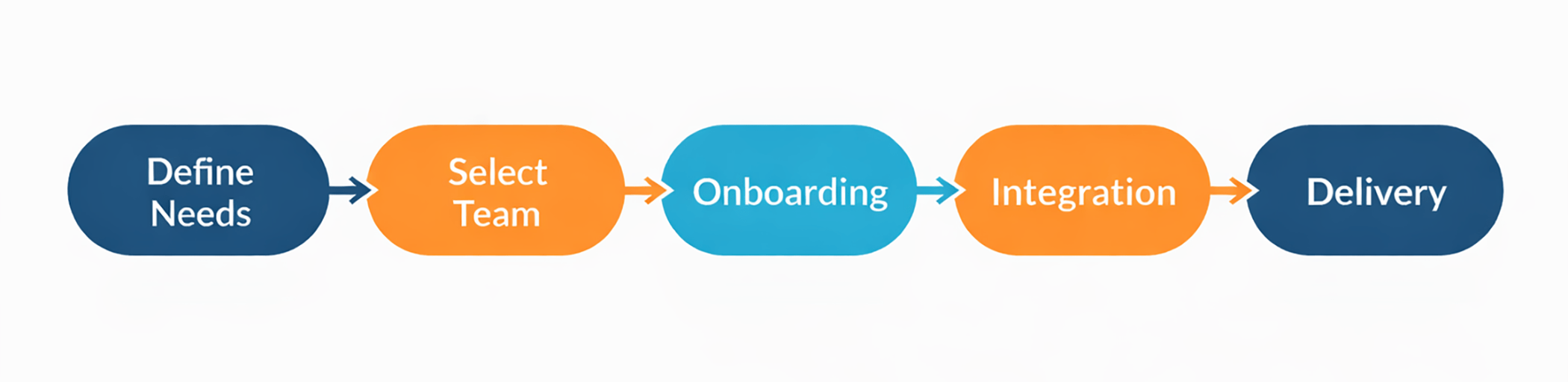
Planning the integration: Before you manage a staff augmentation team
So you’ve decided you need external help. You can’t just sign a contract, throw some external developers into a Slack channel, and expect your velocity to double. The companies that fail spectacularly at this model are the ones that treat external engineers like disposable, plug-and-play resources. Effective staff augmentation management starts long before the first external developer joins your team.
Success requires a methodical, aggressively structured approach before the new hires even get their login credentials. Think of this as your operational baseline.
- Execute a ruthless internal audit: Before you look outward, look inward. Identify the exact, undeniable bottlenecks in your delivery pipeline. Are your senior engineers spending 40% of their week fixing bugs in a legacy system instead of building the new features you promised the board? Is a severe lack of frontend React capacity holding back your perfectly functioning backend API deployments? Do you need specialized compliance knowledge that your current squad lacks entirely? You must define the gap precisely before you spend a dime.
- Define the roles with extreme precision: Vague job descriptions yield catastrophic matches. Do not go to a vendor and ask for a generic “mid-level software engineer.” Specify the exact technology stack. Outline the required years of experience within highly specific frameworks. Detail the necessary domain knowledge. For example, if you need fintech compliance experience, make it a hard, non-negotiable requirement. Document the exact soft skills required to survive in your corporate culture.
- Establish unambiguous internal ownership: An augmented engineer without a dedicated internal manager is a walking liability. Assign a specific internal champion – an Engineering Manager, a Tech Lead, or a Senior Developer. Make them directly, personally responsible for onboarding the external staff. Task them with reviewing the external code and answering the inevitable, highly complex architectural questions. Remember: If everyone on your team is in charge of the new developer, no one is. For more insights on leading hybrid squads, exploring managing offshore developers provides practical, day-to-day frameworks.
- Partner with a vetted staff augmentation company: Avoid high-volume transactional staffing agencies that simply scrape professional networks and forward you unvetted resumes. You need partners who provide pre-vetted, agile-trained engineering teams. Their internal technical vetting process must be rigorous. It must incorporate complex live code challenges. It must feature deep system design interviews. It must include intensive behavioral assessments to verify both technical depth and professional maturity.
- Demand agile fluency: The best providers ensure their engineers are fully prepared before Day 1. Engineers must undergo standardized agile methodology training. They need to participate in code quality workshops. They require specific communication development prior to ever touching a client project. This pre-training is the invisible glue that allows augmented teams to integrate smoothly into fast-paced, highly demanding North American and European engineering environments without suffering a massive culture shock.
How to manage onboarding in a staff augmentation team

The single biggest threat to your newly formed hybrid team is what the industry calls “Integration Overhead.” This is the friction, the wasted hours, and the massive cognitive load placed on your existing senior team as they attempt to bring external developers up to speed on a proprietary, often undocumented codebase.
If you skip structured onboarding, the new engineers will feel entirely lost. They won’t have the business context they need to make smart architectural decisions, and their time-to-first-commit will stretch from a few days into several agonizing weeks. A clear, rapid onboarding plan is the only way to preserve the speed advantage that external staffing is supposed to provide.
To completely kill integration overhead, you must treat onboarding as a critical project deliverable, not an HR afterthought.
The zero-friction onboarding sequence
| Timeline Phase | Mandatory Management Actions | Primary Operational Goal |
| Pre-Arrival (Days -7 to 0) | Provision all software licenses, set up Git repository access, enforce VPN configurations, test access credentials, and formally assign the internal technical mentor. | Completely eliminate Day 1 administrative downtime. The engineer must be able to pull tickets and clone the repository on their very first morning. |
| Week 1 (Context & Architecture) | Conduct a deep, guided codebase walkthrough. Explain the specific agile sprint cadence. Review mandatory security, IP protection, and compliance protocols in detail. | Establish firm technical boundaries, provide core business logic context, and ensure absolute, documented compliance with enterprise security standards. |
| Week 2 (Initial Execution) | Assign the first low-risk, easily measurable bug fixes or minor features. Conduct rigorous pull request (PR) reviews specifically looking for stylistic alignment. Hold the first informal cultural check-in. | Prove initial coding velocity, build the engineer’s confidence in your specific deployment pipeline, and aggressively correct minor stylistic code deviations early. |
| Month 1 and Beyond | Ensure full, active integration into daily stand-ups, retrospective meetings, and sprint planning sessions. Enforce the weekly reporting structure without exception. | Achieve absolute operational parity and deep cultural alignment with the core internal permanent team. |
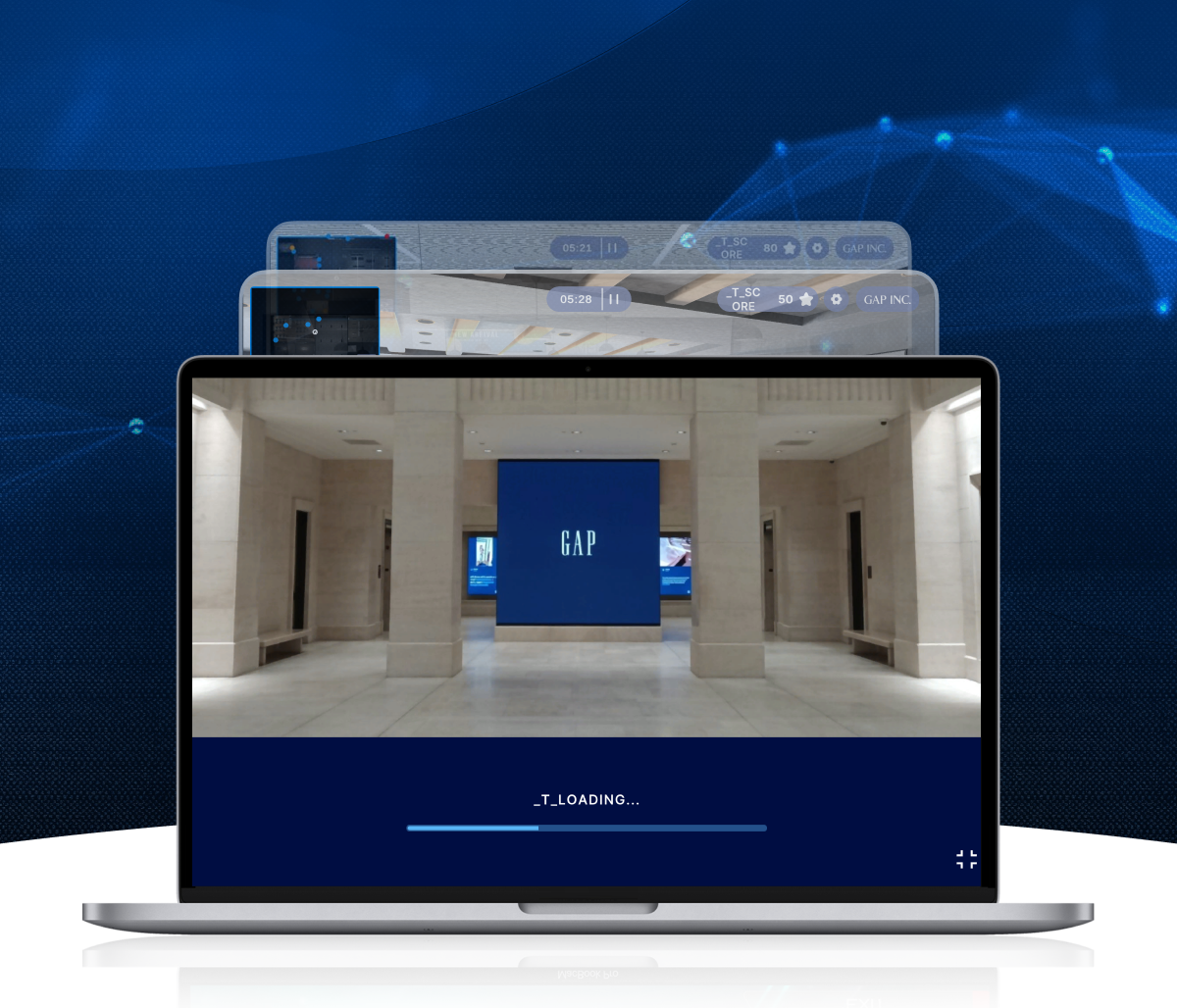
Staff augmentation in practice: Gap Inc.
Five communication pillars to manage a staff augmentation team
Managing external talent requires far more intentional, manufactured communication than managing the people sitting right next to you in a physical office. When physical proximity is removed, organic visibility drops to zero. You cannot just glance across the room to see if a developer looks frustrated or stuck on a complex architectural problem. You have to build rigid systems to surface that reality. Properly executing agile team integration means building guardrails that make ignoring problems impossible. Managing remote developers requires structured communication systems, as informal visibility is completely lost in distributed environments.
If you let communication drift, the project will fail. I have seen it happen repeatedly. Here are the five specific mechanisms required to maintain operational control over an extended team:
- Mandatory weekly progress reports: Every augmented staff member must submit a detailed, written weekly report. This is not corporate busywork. It is a critical velocity tracking tool for management. The report must detail the specific tickets completed. It must highlight technical roadblocks or undocumented legacy code encountered. It should list the specific pull requests submitted for review. It needs to outline the primary focus areas for the upcoming week. This creates a highly visible, searchable paper trail of accountability.
- Deep-dive bi-weekly check-ins: Do not rely solely on rushed, fifteen-minute daily stand-ups to gauge project health. Schedule dedicated bi-weekly, face-to-face virtual meetings specifically focused on the augmented team members. These sessions should focus heavily on larger architectural concerns. Use this time for unblocking complex cross-team dependencies. They should be active, collaborative working sessions, more than passive status updates.
- Honest, constructive performance reviews: Periodic reviews evaluating the external engineer’s output against the initial contract expectations are vital to long-term success. Management must provide direct, unvarnished, yet constructive feedback. Always highlight significant technical achievements to build morale. Simultaneously, point out exact areas where code efficiency, test coverage, or process adherence needs immediate improvement.
- Anonymous employee sentiment surveys: You cannot effectively manage what you refuse to measure, and that absolutely includes team morale. Send anonymous surveys to your augmented workers regularly. Ask them directly about their onboarding experience. Gauge their perception of the internal team culture. Hunt for hidden friction points that they are experiencing with internal staff. This data is invaluable for finding operational problems and dealing with them before they trigger sudden, unexplained turnover.
- Asynchronous feedback in project management tools: Your project management platforms are the actual source of truth for the project. Ensure that your augmented staff are deeply, habitually embedded in these tools. They must be actively utilizing built-in commenting systems. Code reviews should be integrated directly into the issue trackers. They must actively participate in the asynchronous written debates that define all modern software development.
To enforce this, we map out communication protocols actively.
The operational communication cadence
| Meeting Type | Frequency | Required Attendees | Primary Objective |
| Daily Standup | Daily (15 mins) | Entire Hybrid Squad | Quick blocker identification and daily alignment. |
| Sprint Planning | Bi-Weekly (1-2 hrs) | Product Manager, Tech Lead, Hybrid Squad | Assigning velocity points, setting clear scope boundaries. |
| Technical Check-In | Bi-Weekly (45 mins) | Augmented Engineer & Internal Champion | Deep-diving architectural questions and codebase navigation. |
| Retrospective | End of Sprint | Entire Hybrid Squad | Honest feedback on what broke, what worked, and how to improve. |
Security, IP, and risk in a staff augmentation team
When you bring external talent directly into your core infrastructure and hand them the keys to your codebase, you are inherently expanding your organizational attack surface. A mature, professional scaling strategy does not ignore these risks; it actively engineers ironclad solutions to neutralize them before a single line of code is written.
You have to protect the castle. Here is exactly how you do it when integrating external staff:
- Verify vendor certifications: Your service provider must hold up-to-date security certifications explicitly appropriate to your specific industry vertical. If you are in healthcare, finance, or government contracting, you need strict compliance frameworks in place and validated.
- Enforce Role-Based Access Control (RBAC): Internally, you must enforce strict access controls across all code repositories, cloud environments, and databases.
- Maintain siloed access: External engineers should only have access to the exact microservices or repositories they are actively working on. There is zero operational reason for a frontend augmented developer to have read access to your production database credentials or payment processing keys.
- Uncompromising data protection: Data protection policies must be strict, and remote infrastructure must be continuously monitored for anomalies or bulk exfiltration attempts.
- No vague handshakes: Vendor contracts cannot be vague handshake agreements. They must be legally binding and heavily detailed.
- Demand immediate ownership: Contracts must establish undeniable, exclusive intellectual property ownership for your organization from the exact moment the code is compiled on the external developer’s machine.
- Absolute confidentiality: The legal agreements must mandate absolute confidentiality protections regarding trade secrets and proprietary algorithms.
- Ensure ethical parity: You must ensure that the augmented teams are legally bound to operate under the exact same ethical, legal, and security frameworks as your permanent, in-house employees.
Financial structures: Funding your staff augmentation team
One of the most compelling arguments for external team integration is the radical simplification of financial forecasting and administrative overhead. Traditional hiring carries massive hidden costs: recruitment agency fees, internal HR hours, signing bonuses, specialized hardware provisioning, employer taxes, healthcare benefits, and the inevitable, catastrophic cost of bad hires.
Evaluating financial and billing structures
| Billing Structure | Operational Definition | Best Suited For… |
| Hourly / Time & Materials | The client pays a completely transparent, flat monthly or hourly rate per professional. This single rate covers the individual’s salary, all local benefits, taxes, and the provider’s service fee. | Highly agile environments with fluid scopes, ongoing R&D projects, and continuous integration pipelines where feature requirements shift daily based on user feedback. |
| Outcome-Based Billing | Payment is tied explicitly to pre-defined deliverables, strictly enforced performance metrics, or successfully reduced cycle times, regardless of the raw hours worked. | Legacy system migrations, well-defined feature modules, and highly specific projects where the final outcome is entirely predictable and easily quantified by an acceptance environment. |
A massive, often completely overlooked benefit of this model is the total offloading of HR and IT administration. When you partner with a premium firm, their internal HR department handles the payroll execution and benefits administration. They manage the local tax compliance and the complex labor laws of the engineer’s home country. Their IT teams handle the secure access tooling and initial hardware provisioning. This end-to-end operational support frees your CTO and Engineering Managers to focus exclusively on technical direction, software architecture, and product strategy.
The nearshore advantage for staff augmentation teams
For a staff augmentation team, geographic alignment directly impacts communication speed, delivery consistency, and integration quality. Geographic selection plays a massive, often defining role in the success or failure of an extended team. While offshore models have historically been popular for sheer cost reduction, the “Nearshore Model” has rapidly become the unquestioned gold standard for complex, fast-paced enterprise software engineering. You can read more regarding how nearshoring strategies are reshaping corporate agility.
- Real-Time collaboration: The most significant operational advantage of nearshore talent is synchronized time zones, facilitating real-time, instantaneous collaboration.
- Normal business hours: It allows engineering managers to schedule agile sprint planning, host complex architecture debates, and conduct daily stand-ups during regular, shared business hours.
- Eliminating lag: This completely eliminates the exhausting eight-to-twelve-hour communication lag that forces deeply offshore teams to wait an entire business day just to get a single pull request approved or a blocker resolved. When velocity is the core objective, severe time zone disparity is an absolute project killer. Offshore team management becomes significantly more complex when time zone gaps introduce delays in communication and decision-making.
- Shared etiquette: Nearshore partnerships frequently yield much stronger cultural alignment. Regions closely tied to North American or European markets share a similar understanding of business urgency, communication directness, and agile methodologies.
- Reduced friction: This shared professional etiquette heavily reduces the friction of day-to-day management. Providers with established recruitment networks built over two decades ensure that the professionals they supply are culturally primed to succeed in highly demanding, opinionated enterprise environments.
Long-term strategy to manage a staff augmentation initiative
While injecting external talent is a brilliant, highly effective solution for urgent capacity needs, technology leaders must remain continuously vigilant against the long-term dangers of over-reliance. If you manage this process poorly, you can accidentally destroy your company culture.
- The Resentment trap: If an organization utilizes external staff exclusively to build all the exciting new features, while forcing the internal permanent team to handle nothing but grueling legacy maintenance, bug fixes, and operational support, deep resentment will build immediately.
- Knowledge drain: If you rely entirely on augmented staff without simultaneously investing heavily in the hiring, growth, and upskilling of your permanent internal employees, you risk hollowing out the foundational knowledge base of your company.
- Maintaining balance: You must maintain a strict balance. Use external talent to support, accelerate, and augment your core team, not to replace the internal engineering culture entirely. Short-term thinking solves today’s sprint but ruins next year’s product launch.
The fastest way to completely destroy the productivity and morale of an augmented engineer is to treat them as a disposable, second-class contractor. True engineering velocity is achieved through psychological safety and team inclusion.
To build a high-performing, genuinely unified hybrid culture, you must adopt these practices:
- Provide communication access: Include external engineers in standard team communication channels and casual channels.
- Ensure social inclusion: Invite them to virtual social events, project post-mortems, and company all-hands meetings.
- Deliver total transparency: Provide them with the exact same architectural context, roadmap visibility, and business logic documentation as your internal staff.
- Offer public recognition: Recognize their technical achievements publicly during sprint retrospectives.
- Foster psychological ownership: When an engineer feels genuinely invested in the success of the product – rather than feeling like a temporary mercenary – their output quality, their attention to critical edge cases, and their dedication to long-term code maintainability increase exponentially.
There is also a massive, quantifiable benefit to diversifying your team beyond local borders. Expanding your team inherently diversifies the thought processes, architectural assumptions, and problem-solving approaches within your engineering unit. Extensive research by McKinsey highlights this reality clearly, revealing that companies with greater ethnic and cultural diversity are 35% more likely to achieve financial performance significantly above their respective industry averages. Different backgrounds lead to different architectural perspectives, forcing teams to confront their biases and build more resilient solutions. Remote staffing isn’t just convenient; it is a measurable strategic advantage.
The clean offboarding process for an IT staff augmentation team
In a volatile economic climate, the ability to rapidly reduce headcount without triggering the legal, financial, and severe emotional nightmares of corporate layoffs is incredibly valuable. This is the quiet superpower of the augmented model.
- Zero drama scaling: When a specific project phase concludes, or when market conditions require immediate budget tightening, the offboarding process is entirely clean.
- Shielded liability: The engagement ends, and the professional simply returns to the service provider’s internal talent pool. Your organization is completely shielded from negotiating painful severance packages, dealing with complex unemployment claims, and managing the devastating internal morale shock that always accompanies internal team layoffs.
- Mandatory knowledge transfer: To ensure that no technical debt or undocumented code is left behind, standard industry contracts mandate reasonable notice periods – typically between two and four weeks.
- Clean transitions: This essential window guarantees sufficient time for comprehensive knowledge transfer, rigorous final code reviews, and a clean, highly professional transition of system ownership back to your core internal engineering team.
Conclusion: Strategic workforce planning for 2026
For engineering executives mapping out their 2026 technical roadmaps, tactical resource allocation dictates everything. In a market crippled by a severe tech talent shortage, waiting for traditional HR pipelines to slowly process a background check is the easiest way to miss an irreversible product release window. You must provision talent dynamically.
The immediate next step for any forward-thinking leader is a ruthless, potentially uncomfortable audit of the current delivery pipeline. These steps reflect core IT staff augmentation best practices that help companies scale engineering capacity without losing control over delivery. To execute this scaling model with precision and navigate a volatile talent market, you must take three specific actions:
- Isolate the bottlenecks: Pinpoint the exact intersections in your workflow where a lack of specialized expertise is actively suffocating your sprint iteration cycles.
- Define the gaps: Document the exact roles, necessary tech stacks, and domain knowledge required before looking outward.
- Select the right partner: Choose an organization with a verifiable track record of delivering integrated technical excellence, rather than a transactional agency that just forwards a stack of unvetted resumes.
You must treat a staff augmentation team not as a temporary fix, but as a structured, long-term capability within your operational toolkit.
If you are ready to scale your engineering capacity with a structured staff augmentation team, partnering with a proven innovative solutions integrator is the next logical step. We integrate high-performing engineers into your existing team, ensuring full control over delivery while accelerating your product roadmap.