
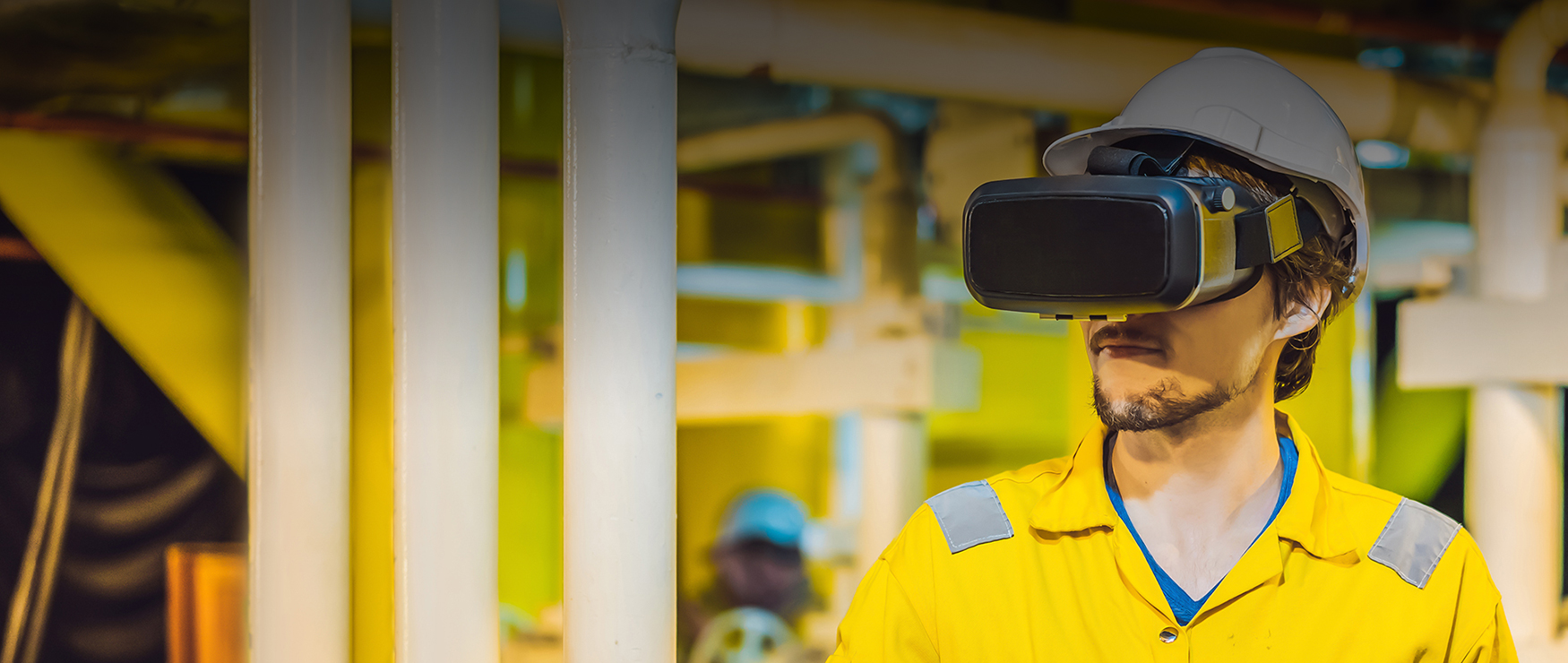
VR training for oil and gas puts workers through gas leaks, fires, rig evacuations, and equipment failures in a headset, where a mistake costs nothing.
It cuts the travel, downtime, and risk of live drills, and lets a team repeat a high-stakes procedure until the response is automatic. This guide covers what VR training does for oil and gas operations, the program types, how it compares to traditional methods, and how to implement it.
Beyond the safety gain, VR training gives supervisors real-time performance data, so they can see who is ready and where a crew needs more practice.
Teams run the same scenario repeatedly, which is exactly what emergency readiness demands. Because the training is in a headset, it also removes the geographic constraint: a company with sites across regions trains everyone to the same standard without flying people in.
VR training also cuts the cost tied to conventional methods.
There is no need to halt operations for a classroom session or send workers to a distant facility, and modules can be tailored to a specific task so each employee gets relevant instruction rather than a generic course.
Why VR fits oil and gas training
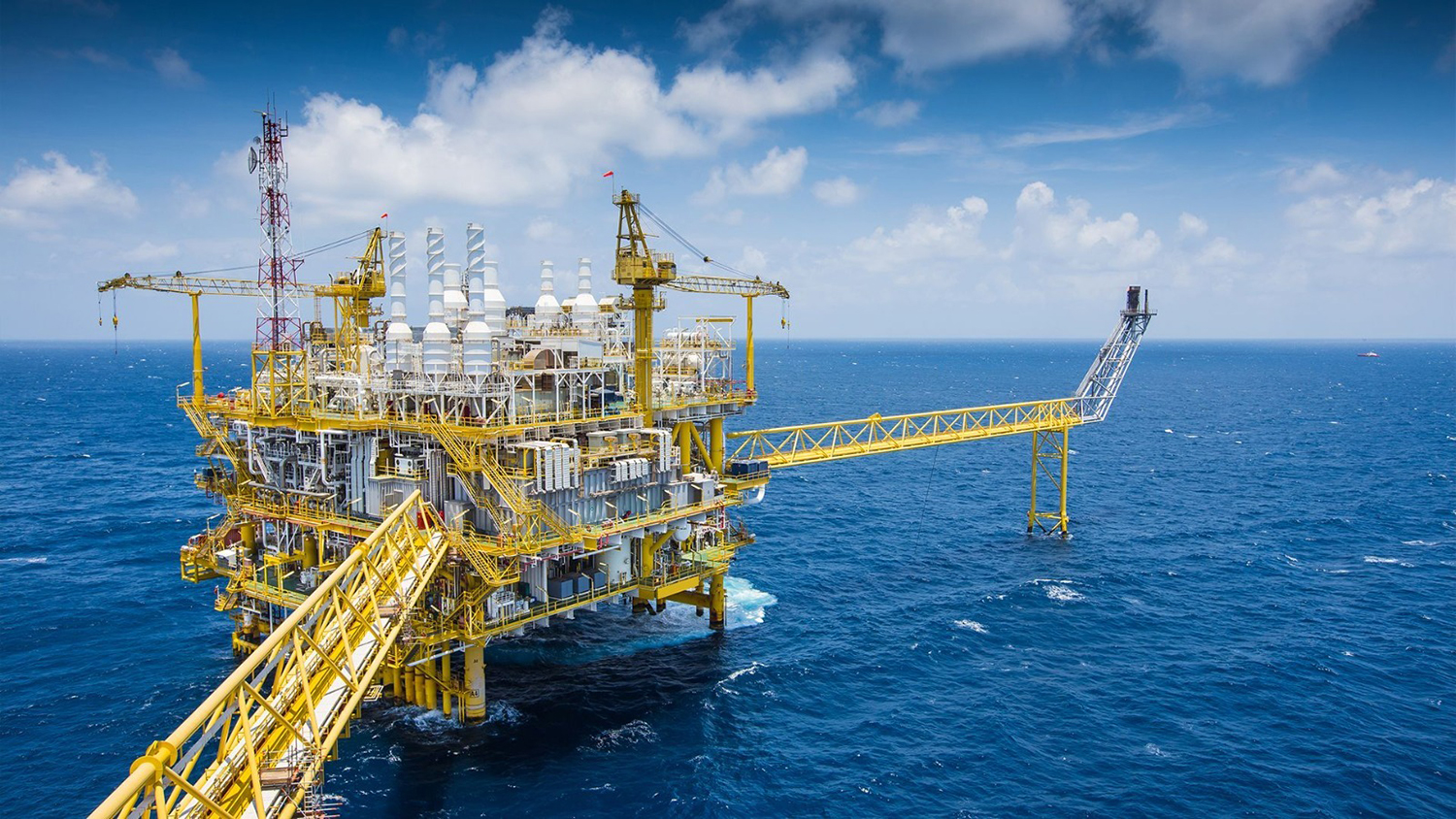
The oil and gas industry has to prepare people for tasks that are dangerous to rehearse for real.
VR training simulates those environments, from equipment failure to full evacuation, so workers gain practical experience without exposure to harm. It can also cover chemical safety training, letting employees practice handling hazardous materials in a controlled virtual setting. Well-built programs save time and improve performance because the scenarios match a worker’s real responsibilities.
Improving safety with immersive drills
Safety is the industry’s first priority, and VR-based simulation training improves outcomes without putting anyone at risk.
Workers practice responding to gas leaks, fires, and equipment failures, and because they can repeat each drill, the correct response sticks. Offshore teams rehearse evacuation in detail so they act with precision in a real emergency, while onshore workers focus on hazardous chemicals or malfunctions. Programs adjust to each site’s specific safety requirements.
Simplifying complex training programs
Complex procedures in oil and gas are hard to teach from a manual.
VR makes them interactive: a worker engages with virtual equipment to practice pipeline management, offshore drilling, or heavy-machinery operation step by step. Modules adapt to different job roles so each worker gets what applies to them, and teams complete training faster and move to real work with more confidence. Because the programs scale across locations, a company can train entire teams to a consistent standard regardless of where they are.
Reducing cost with repeatable modules
Traditional training carries real cost: travel, equipment setup, and operational downtime.
VR replaces most of it with immersive, repeatable modules. In a controlled environment, employees practice equipment maintenance or emergency procedures as many times as needed, and the same module trains teams at multiple sites at once. Because virtual reality simulations are reusable, the long-run cost per trained worker drops sharply, without sacrificing quality or safety.
VR training vs traditional methods
Virtual simulation beats traditional oil and gas training on the metrics that matter.
Classroom instruction and physical drills are costly and often stop short of real practical application. VR trains workers for hazardous environments and complex operations without disrupting production or risking safety, and it does so repeatably: rehearsing a scenario again costs nothing beyond the headset time. Teams train remotely, cutting travel and equipment shutdowns, and every scenario maps directly to a worker’s actual role. The result is more flexibility, lower cost, and better-prepared crews than conventional approaches deliver.
Types of VR training programs in oil and gas
VR training in oil and gas covers a wide span of operational needs. The most common program types are:
- Safety and emergency response. Workers rehearse gas leaks, fires, and explosions in simulation, building readiness without real exposure.
- Equipment operation. Employees learn heavy machinery and complex tools virtually, avoiding accidents during their first hands-on attempts.
- Offshore platform operations. Crews learn platform-specific processes such as evacuation and rig maintenance.
- Hazardous material handling. Focused modules cover safe handling and disposal of dangerous substances, cutting exposure risk.
- Pipeline maintenance. Technicians train on inspection, repair, and safety protocols to reduce failures in real operations.
Each program targets a specific task and role, giving hands-on practice without interrupting daily operations, and each scales to remote teams for cost-effective, consistent learning.
The business impact of VR training
VR training produces measurable results in oil and gas: less downtime, lower operational risk, and higher safety.
Workers gain hands-on experience in emergency response, hazardous-material handling, and equipment operation without interrupting the day’s work. The technology scales training, trims travel expense, and delivers repeatable, role-specific modules, so virtual reality simulations translate into cost savings, safer sites, and a more skilled workforce.
Emergency response in high-stakes settings
Emergency response is where VR training earns its place.
Workers rehearse life-saving protocols in realistic, high-pressure scenarios, from gas leaks to fire evacuations, and repeat them until confidence and reaction time improve. VR prepares teams for split-second decisions under stress: offshore platforms simulate full evacuations, onshore crews practice emergency shutdowns. Repeated exposure in the headset reinforces the correct behavior so each worker is ready for the emergencies specific to their environment.
Equipment handling for maintenance teams
VR lets maintenance crews practice equipment handling and repairs with no risk to people or hardware.
Technicians run machinery inspections, diagnostics, and repairs virtually, learning the procedure before touching real equipment, which cuts accidents and prevents costly downtime. Practicing routine maintenance on heavy machinery or pipelines in simulation builds the technical skill and confidence a crew needs under pressure, and it lets a company standardize maintenance practice across every site.
Risk identification with digital twins and simulation
VR training helps teams prepare for hazards by letting them identify risk in a controlled environment.
Simulations recreate chemical spills, equipment malfunctions, and fires so workers experience the danger without the consequences. There is a useful distinction here: a simulation runs a scenario against predefined conditions, while a digital twin mirrors a specific real-world asset with live data. In practice, teams use both, as our breakdown of digital twin vs simulation explains: a digital twin might mirror an offshore platform for monitoring and specific-malfunction drills, while simulations cover hypothetical events like evacuations. Combined, they give complete preparation and faster response.
Tailoring VR training to your operation
Off-the-shelf courses rarely fit oil and gas, because every operation carries its own risks and tasks.
VR programs can be customized to mirror a company’s real operations, so an offshore rig operator trains on evacuation while a maintenance crew trains on equipment-specific repairs. That relevance is what makes the training stick.


Why customization matters
Each operational environment presents unique risks, so generic training often misses the point. Custom VR delivers:
- Targeted skill development. Employees build the exact expertise their role requires, improving real-world performance.
- Realistic risk preparation. Modules simulate the hazards unique to the company’s operations, sharpening response and safety.
- Higher engagement. Training that matches daily work holds attention, which improves retention and application.
Building immersive, engaging modules
Engaging modules keep workers focused while they build practical skill.
VR creates an interactive environment for tasks too risky or expensive to rehearse in reality, such as intricate pipeline repairs or emergency procedures. Training becomes memorable because a worker engages directly with a scenario tied to their role, and the format sharpens problem-solving as they make quick decisions under realistic pressure.
Flexible and scalable
Custom VR scales to teams of any size or spread.
Whether training a specialist group or a large distributed workforce, VR adapts and cuts the logistics and expense of conventional training. Programs update quickly, so when procedures change, a module is refined or expanded rather than rebuilt, keeping the whole workforce aligned to current standards across every location.
Unconventional approaches that work
The industry is moving past straight simulation toward methods that improve retention: gamification, immersive storytelling, and psychologically grounded learning. These make training more engaging and help skills stick.
Gamifying training
Gamification shifts VR training from passive instruction to active participation by adding scoring, challenges, and leaderboards. Workers engage more when they can track progress and compete, and rewarding completion of a complex task under time pressure reinforces key concepts. The core gains:
- Higher motivation. Progressing through levels and challenges keeps employees learning.
- Better retention. Repetitive, interactive tasks make skills and knowledge stick.
- Stronger collaboration. Team-based tasks improve communication and joint problem-solving.
The psychology of better retention
VR training taps how the brain remembers.
Unlike passive observation, VR engages multiple senses, which makes the experience more memorable and easier to recall long-term. Simulating a real situation triggers an emotional and cognitive response that reinforces memory: an emergency drill in VR creates a genuine sense of urgency, activating the fight-or-flight response and locking in the learned behavior. Role-based scenarios further engage problem-solving, deepening the learning.
Collaborative training in risk scenarios
Collaborative VR lets oil and gas teams rehearse high-risk scenarios together with no real danger.
Members work through emergencies, malfunctions, and hazardous-material handling as a group, strengthening communication and joint problem-solving. Simulated risk scenarios build coordination and quick decision-making, and real-time interaction between participants makes the training especially effective for complex tasks needing precise role distribution. The gains are better teamwork, sharper group problem-solving, and realistic practice against the risks a crew actually faces.
The future of VR training for oil and gas
VR training in oil and gas will keep advancing alongside the technology. Expect deeper use of AI and machine learning to tailor programs further, faster and more effective training as hardware becomes more accessible, and modules that evolve with industry demands. Two shifts stand out.
Sensory feedback
Adding haptic feedback, sound, and even temperature cues makes VR training more realistic.
When a worker feels the weight of a virtual tool or hears a machine’s operation change, the training engages more senses and retention improves. Emergency drills that simulate equipment vibration or environmental change build a heightened awareness that closely mirrors on-site conditions, and the range of simulated sensations will keep widening.
VR plus data analytics
Pairing VR training with data analytics sharpens both learning and operational insight.
As workers complete modules, the system records performance and flags where they excel or need work, so trainers tailor the next session to specific gaps. Metrics like task-completion time, accuracy, and decision-making reveal a workforce’s real capability and surface potential risk before it escalates. This lets a company measure training impact in ways traditional methods cannot, producing better-prepared teams and more efficient operations.
Five ways to implement VR training
VR training offers several methods oil and gas companies can tailor to their operational needs:
- Simulated emergency drills. Immersive crisis scenarios, from gas leaks to equipment malfunctions, let workers rehearse responses so they act with confidence when it counts.
- Equipment operation modules. Training on virtual replicas of heavy machinery builds familiarity before workers handle it in the field, cutting first-attempt errors.
- Role-specific programs. Modules customized per job role keep training relevant, whether the focus is offshore drilling or refinery management.
- Team collaboration scenarios. Virtual environments let teams solve problems and manage high-pressure tasks together, improving coordination without live-training risk.
- Ongoing skill assessment. Data analytics in VR track performance continuously, so companies spot gaps and adjust content to keep the workforce current.
VR training for oil and gas with Program-Ace
Program-Ace has developed immersive software since 1992, across 900+ projects, and builds VR training tailored to the specific risks of oil and gas. Our work covers role-specific programs, simulation training, and collaborative VR environments for team coordination, all aimed at better safety, retention, and operational efficiency.
The approach is built around each client’s operation rather than a template, so companies get modules that mirror their real scenarios in a risk-free environment. To scope a VR training program for your teams, whether for emergency response, equipment handling, or offshore operations, contact us.