

React Native app development lets one team ship an iOS and Android app from a single JavaScript codebase, with close to native performance. It is why more than 4 million apps run on it today, including Instagram, Facebook, and Shopify. This guide walks the six steps to build a React Native app, from validating the idea to launching it.
Looking for React Native development services?
If you have researched React Native as the technology for your app, the adoption numbers back the choice. React Native holds around 13% of the mobile app market and sits at roughly 32% of all cross-platform development as of 2024, second only to Flutter. Its share of newly released apps rose from 4.73% in 2022 to 6.75% in 2024, so the base is still growing.
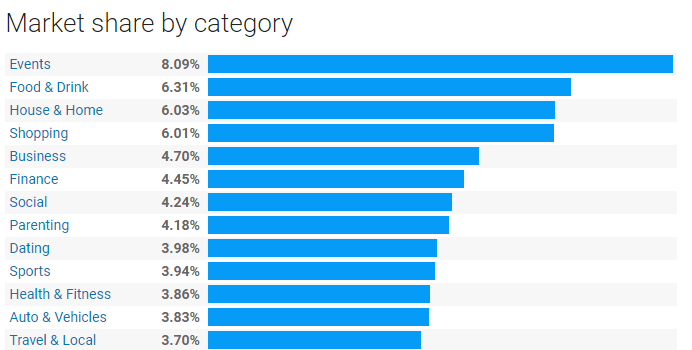
React Native powers apps from Instagram, Facebook, Shopify, Discord, and Coinbase, among others. The framework earns its place through code reuse: teams report 60 to 80% of code shared across iOS and Android, which is where most of its cost saving comes from. The question is how to apply it to your product, whatever industry you are in.
Whether you want a React Native app tailored to a specific industry or a general investment in React Native app development, start with the basics.
Step 1. Research and validate your idea
Whether you are building a web app with React Native or a mobile one, research the idea first: decide which functionality the app needs and confirm React Native can deliver it. The framework covers a wide range, but you still need a checklist of features, core functions, and services specific to your product.
A defined list of features and references speeds up development and lowers cost when you hire React Native developers, because scope is agreed before anyone writes code.
If this is your first app, starting a React Native build from a blank page is hard. Study what already exists in your category and adapt it to your business vision rather than inventing every pattern yourself.
Step 2. Analyze the market and find React Native app examples
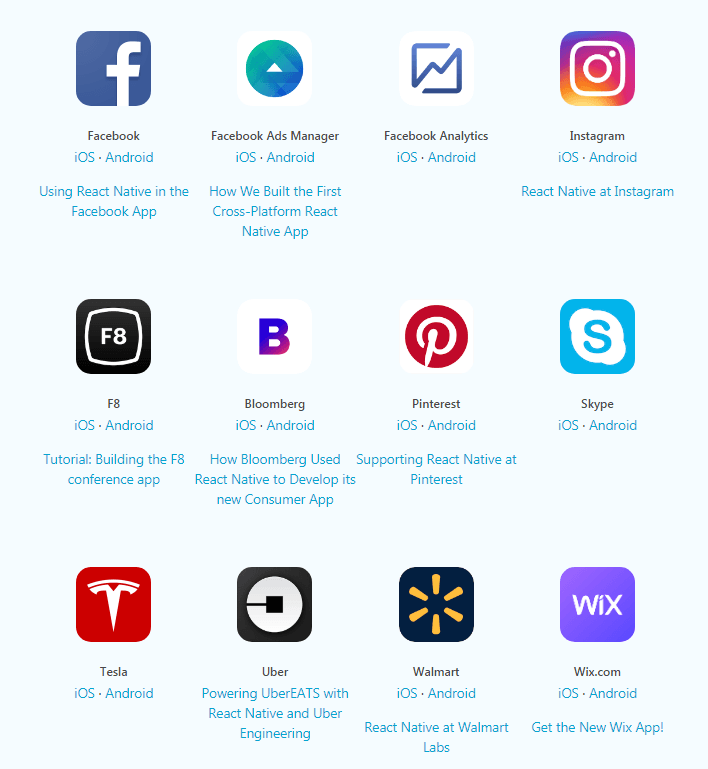
Competition is a good sign, not a warning. It means the idea is valid and you are not reinventing the wheel. Run market analysis on the two major stores:
Work through the apps relevant to your industry and audience, and document every function that looks useful and proven. The image above shows apps already built with React Native, and the framework’s own site keeps a showcase of React Native app examples.
Step 3. Learn React Native capabilities and features
Depending on the app you want, it helps to know React Native can build the interface effects developers ask about most, the ones William Candillon covers on his channel:
- App Store shared transitions
- Pull-to-refresh interactions
- Scrollable headers, intros, and card-flip layouts
His series “Can it be done in React Native?” is a practical reference when you are deciding whether a specific feature is feasible in the framework.
React Native is an open-source framework for building mobile interfaces, capable of layouts, animations, and effects of varying complexity while keeping the code shared. The traits that earned it a reputation as a serious mobile framework are below.
| Features | Code reusability |
| Platforms | Cross-platform capabilities with native performance |
| Architecture | Component-based architecture |
| Development | Rapid development |
| License | MIT license (free) |
React Native also connects to a wide range of platforms, including the Windows family of devices such as desktop, Xbox, and Surface Hub through React Native for Windows.
Step 4. Plan your budget
Budget usually matters most in mobile app development, and React Native is built to stretch it. If you already employ front-end developers, they can build a React Native app, because the framework is JavaScript and uses core React syntax, so the team’s existing skills carry over.
Cost depends on the app’s functionality and how unique and complex those features are. It is calculated across the standard development stages:
- Business analysis and documentation
- Design and prototyping
- Development and QA
- Support and maintenance
Step 5. Build it in-house or hire React Native developers

Your in-house front-end team can handle a React Native build. But web design and shipping a production app are different disciplines, so many companies bring in dedicated React Native developers at Program-Ace instead. Our React Native team has shipped across several industries, including:
- Social media and communication
- Entertainment
- Photography and design
- Marketing and advertising
- Healthcare
- Automotive
One entertainment and communication project was an app called BoutThat.
BoutThat
BoutThat runs rapid, 90-second debates on topics from politics and culture to sports and technology. The idea is to pull users into active discussion, share knowledge, and have fun while surfacing insight on a subject.
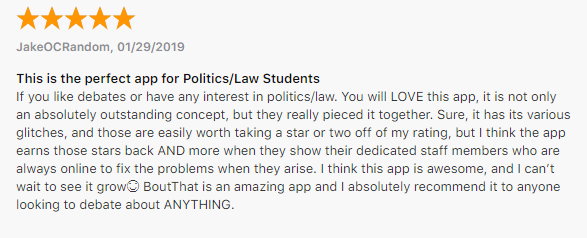
Its main features include:
- Live chat
- Debate scheduling
- Streaming to Facebook Live or Twitch
- Voting and sharing
- Mailchimp integration
- Notifications
BoutThat was built with React Native and Node.js, a live example of the framework’s fit for a real-time, communication-heavy product.
Step 6. Market your React Native application
The last step is to market the app before it launches, not after. Most teams start marketing near the release date, upload to Google Play and the App Store, and hope it goes viral. There is a better order.
Market before going live and you gather impressions and leads that feed app testing and early access. Run closed alpha and beta rounds to see how the app performs, then fine-tune or add features. Pre-launch marketing also builds an email list of users already interested in the product before it ships.
At Program-Ace, we make sure no app is wasted: thorough business analysis, hypothesis validation, and A/B testing with a real audience raise the odds that the app succeeds.
Conclusion
React Native is a practical choice for rapid app development, from fast cross-platform prototyping to full-cycle delivery, with code that ports between mobile and web. Many companies choose it for that flexibility, and Program-Ace, delivering software since 1992, can be your technology partner when you need to build a React Native app.
For more on our React Native app development work or a consultation, explore our custom software development services or contact us.