
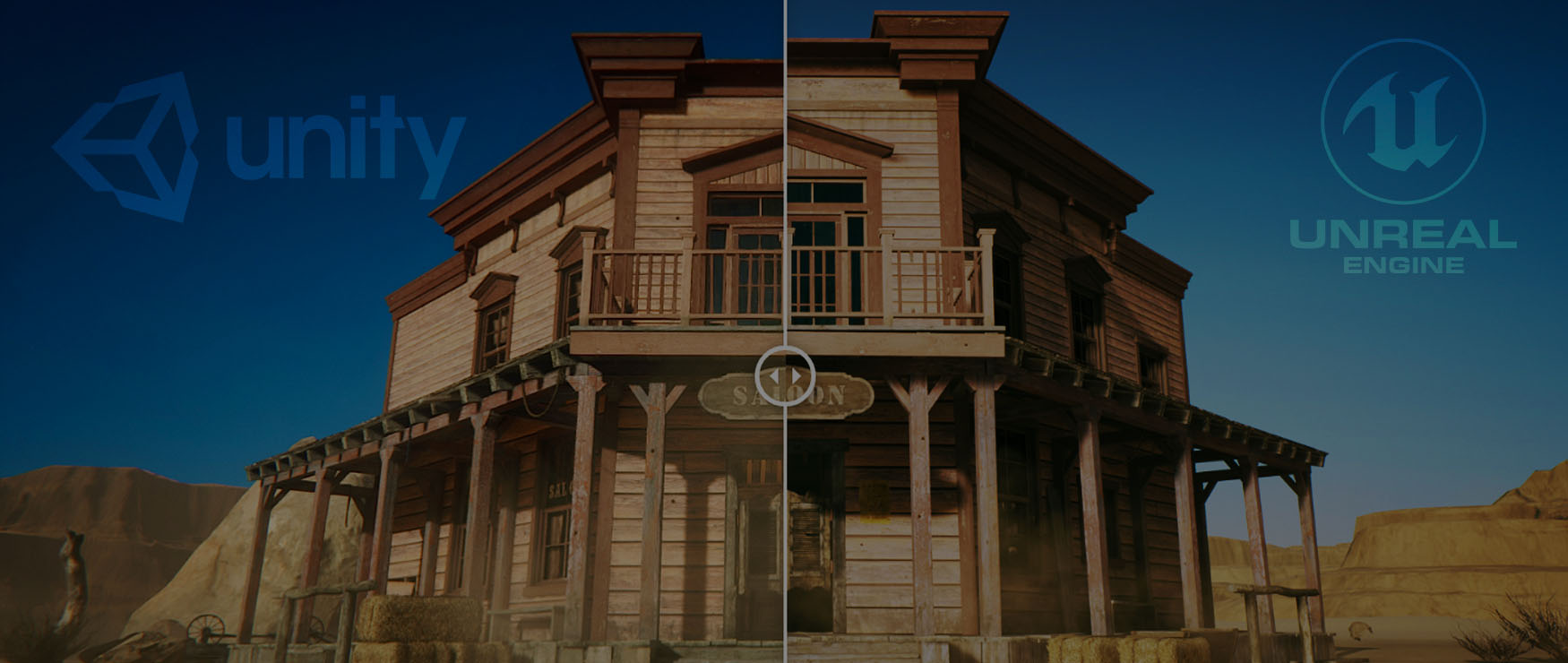
Unity vs Unreal Engine in 2026 comes down to fit, not a winner: Unity leads mobile, XR, and indie development with about 24% market share and roughly 70% of top mobile games, while Unreal Engine dominates cinematic, AAA, and virtual-production work with its Nanite and Lumen rendering. Unity is free until $200K in revenue, then about $2,310 per seat per year; Unreal is free until $1M in lifetime revenue, then a 5% royalty (waived on the Epic Games Store).
Below is the full comparison to match the engine to your project.
Studios and product teams continue to choose between Unity and Unreal Engine when planning new interactive projects.
The interest has not faded. If anything, the decision has become more cautious and more business-driven. Many companies first consult Unity development experts or experienced Unreal Engine teams to understand real production implications before committing.
In 2023–2024, both engines were constantly compared. Discussions focused on licensing changes, performance benchmarks, and workflow differences. A few years later, that context feels outdated. Unity has concentrated on reinforcing its ecosystem and maintaining cross-platform strength. Unreal has continued refining high-end rendering and large-scale production tools.
Software development moves quickly. Three years is enough to shift priorities, rebuild trust, and redefine market expectations. Because of that, earlier comparisons no longer reflect present conditions.
We are revisiting the topic to look at Unity and Unreal as they stand in 2026, based on current capabilities rather than past headlines.
What was the state of Unity and Unreal engine in previous years?
In case you are new to the conversation, the first thing you should know is that Unity and Unreal Engine are two of the most prominent engines used for software development today. Though both started as tools for game building, they have evolved into much bigger and better platforms.
Let’s take a closer look at the changes and current state.
Over the years…
| Unity | Unreal Engine |
| 2005 – the first open-use version of the engine launches, being met with quick acclaim. | 1998 – the first version of UE debuts with the release of the game Unreal. |
| 2007 – launch of v 2.0. | 2002 – launch of v 2.0. |
| 2010 – launch of v 3.0. | 2006 – Unreal Engine 3 is released, being applied for its first AAA titles – Gears of War and Mass Effect. |
| 2015 – Unity 5 launches. It is a major breakthrough, with support for dozens of new platforms, major graphic improvements, HD video support, and VR. | 2014 – Unreal Engine 4 is released with major improvements to graphics and scripting. It achieves widespread use, being adopted in the creation of hundreds of major video and mobile games. |
| 2017 – direct integration with top 3D design tools (3DS Max, Maya) is added. | 2016 – support for VR application development is added. |
| 2018 – the first in-engine machine learning tools are introduced, along with a rendering pipeline for traditional and immersive platforms. | 2019 – support for real-time ray tracing is added, along with additional rendering output options. |
| 2019 – DOTS, an innovative data-oriented tech stack is introduced for massive improvements to processing performance. | 2020 – UE5 is announced, with a planned release in late 2021. This iteration is expected to provide notable improvements to photogrammetry, LOD optimizations, and asset creation. |
| 2020 – integration for BIM 360 is added; a solution called Unity Forma is made available for easy creation of 3D marketing content. | 2021 – the audience obtained the opportunity to test out Unreal Engine 5 in early access, with all the premium technologies onboard, including MetaHuman, Lumen, and Nanite. |
| 2021 – the Unity 2021 Long Term Support (LTS) was introduced, helping developers optimize their workflows as well as take advantage of the new rendering capabilities. | 2022 – in addition to previously introduced innovative technologies Lumen and Nanite, Unreal Engine improved social media integration as well as released the new MetaHuman version. |
| 2022 – improvements in the Package Manager, UI Toolkit, and Extensible Editor, performance increase, new features in the Splines creation tool, etc. | 2023 – Over 2 million games powered by the engine. Developer community exceeds 7 million people. September 6: Launch of Unreal Engine 5.3, featuring improvements to core rendering systems like Nanite and Lumen and introducing experimental features for rendering, animation, and simulation. |
| 2023 – Mobile games made with Unity account for 71% of the top 1000 titles on the market. The user base (developers + users) amounts to over 2.7 billion people. | 2024 – June: Release of Unreal Engine 5.4, focusing on performance optimizations, including enhancements to Temporal Super Resolution (TSR) and support for Vulkan Ray Tracing. |
| 2024 – October 17: Release of Unity 6, emphasizing enhanced stability, customizable graphics rendering, and simplified multiplayer development. | 2025 – January: Introduction of Unreal Engine 5.5, showcasing MegaLight technology for improved real-time lighting and integrated animation systems. |
| 2025 – Unity 6.1 ships with Deferred+ rendering, foldable and large-format screen support, and the CoreCLR runtime migration for faster iteration. 2026 – Unity 6 adds built-in AI tools (Unity Assistant and Generators) and the GPU Resident Drawer, cutting draw calls up to 4x in heavy URP scenes. | 2025 – Unreal Engine 5.5 introduces MegaLights for real-time lighting at scale and a built-in animation toolset. 2026 – Unreal continues extending Nanite, Lumen, and World Partition to push photoreal AAA and virtual-production workflows further. |
| 2026 – Unity 6.4 is released, integrating the Entity Component System (ECS) and Project Auditor into the Editor and improving rendering and development workflows. | 2026 – Unreal Engine 5.8 is released, expanding procedural worldbuilding, improving animation and lighting workflows, and introducing experimental terrain and vegetation creation tools. |
Is Unreal engine harder than Unity?
This question is a major concern both for new developers and businesses looking to hire devs.
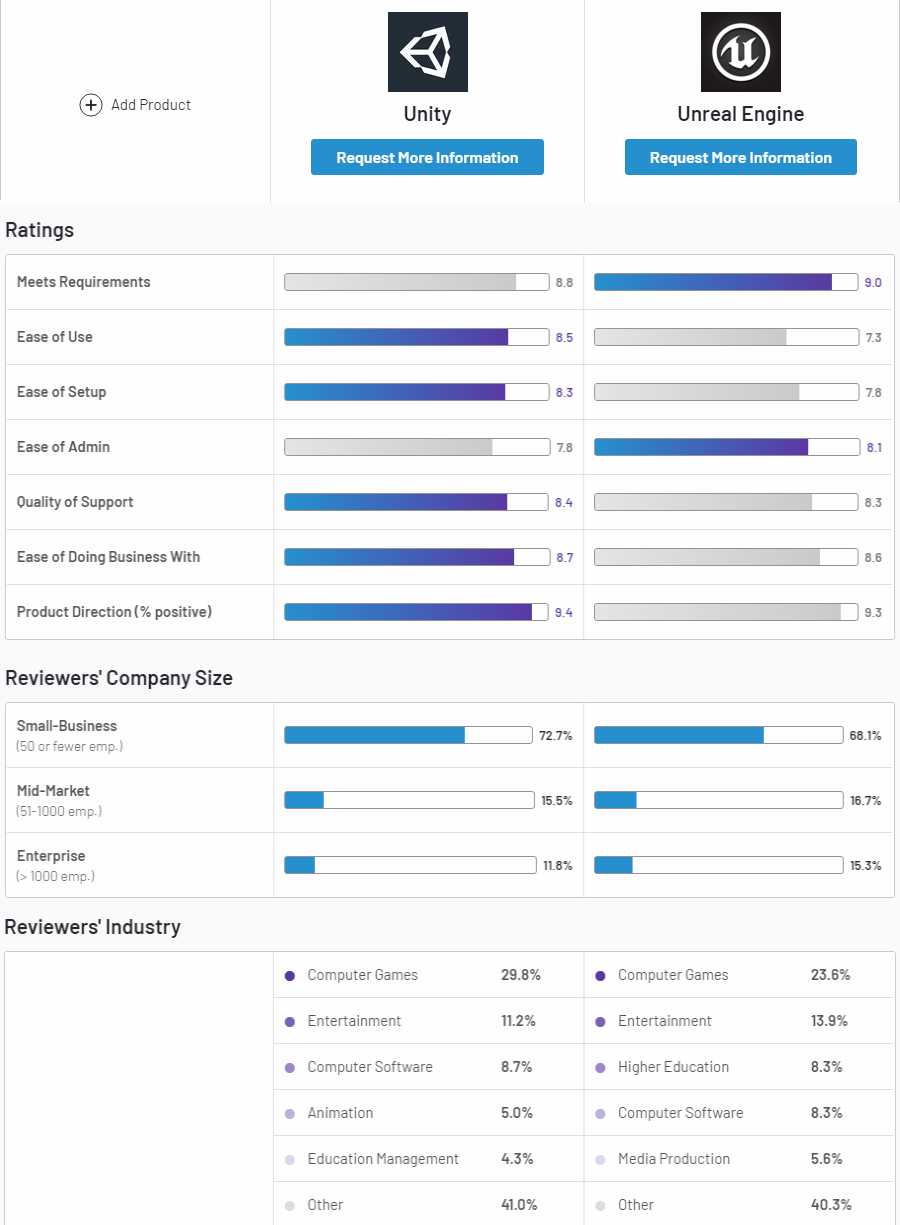
In terms of hiring specialists or forecasting their productivity, there should be no immediate worries.
After all, tens of thousands of devs in both categories (Unreal Engine/UE) are working on the market nowadays, many of them through freelance and outsourcing services. Companies often partner with a unity development company to scale development without expanding in-house teams.
The current versions of the engines are very well-optimized, so most competent specialists should be able to make full use of them at least until major overhauls like Unreal Engine 5 are launched. Even then, you can still choose to work with previous versions of the software.
In terms of learning, there will be a significant level of difficulty regardless of which platform is chosen, you can expect months of just learning the basics.
Still, many devs who have worked with both options admit that Unity is much easier to jump into, simply because of the more streamlined and understandable language of C#.
What are the limits of Unity vs Unreal engine app development?
Before you choose the engine for your next app, you will certainly need to make sure that it supports the type of project you are envisioning.
Apps by purpose (with examples):
- Enterprise apps (for company’s internal use)
- Client-side apps (commercial)
- Game & Entertainment apps
No limits here. As we have mentioned, both engines are currently used for much more than games, so you can use either for your project, even if you never plan on sharing it with the world.
For a closer look at enterprise training, digital twins, configurators, and immersive use cases, see how Unity software development extends beyond gaming.
Apps by platform:
- Desktop
- Mobile
- AR/VR/MR
- Console
- Web
- Android TV
Mostly the same. Nearly all the listed platforms are supported on both, except for Android TV, which is unavailable on Unreal Engine.
Expectations for development
Though the two engines let you accomplish most of the same things on a broad scale, there are undoubtedly differences when it comes to the nitty-gritty of development. Below are some of the peculiarities you or your team may face throughout the process:
| Unity | Unreal Engine |
| Mobile apps | |
| Unity was built with mobile apps in mind, so development for these devices is very streamlined, both for 2D and 3D titles. Most of the optimizations are meant for small and indie games with limited processing requirements. | Using the powerful graphic capabilities of Unreal Engine is overkill for most mobile apps, yet the UE optimization for high-processing apps makes it more suitable for AAA titles and those geared toward high-end devices. |
| Immersive apps | |
| Immersive apps based on VR/MR/XR technology are supported in both engines, but the option of Unity is perfect for prototyping and experimenting with functions. The same is for Unity metaverse development. | This is the superior choice for immersive assets designed with a great level of detail. It also offers a lower barrier of entry into immersive design thanks to its Blueprints system. |
| Graphics | |
| This software provides a few impressive graphical features from the onset (e.g. global illumination and physical-based rendering), but achieving better visuals often involves plenty of tinkering/editing. | In addition to the impressive default graphic features provided by its counterpart, Unreal Engine assets often look polished right out of the box thanks to a wide range of presets. |
| Community | |
| The asset store on the company website is massive and filled to the brim with 3D assets, with some smaller yet notable collections of 2D assets, templates, and VFX. Learning materials are galore on the platform website. | While Unreal Engine’s asset marketplace is smaller, it also offers a decent variety, mostly focused on game elements. Devs are supported with countless manuals and forums. |
| Cost | |
| The most basic plan (Personal) is free to use, but the annual subscription fee has increased by 8%, now costing $2,200 per seat, up from the previous $2,040. This change took effect on January 1, 2025. | This option is free to use, but engages a royalty system that kicks in as soon as an app is monetized, bringing the company (Epic Games) 5% of earnings. |
Unity vs Unreal engine market share in 2026
Market share reflects where each engine won its audience.
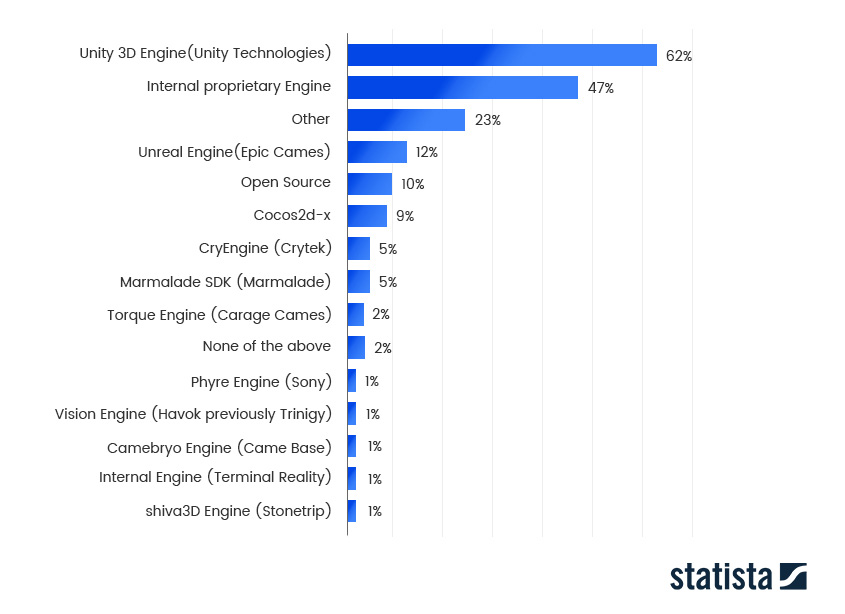
In 2026 Unity holds roughly 24% of the game-development engine market against Unreal Engine’s 16%, and Unity powers about 70% of the top-grossing mobile games. The numbers tell a story of specialization rather than a single leader: Unity spread widest across mobile, XR, and indie studios, while Unreal concentrated in high-end console, PC, and virtual production.
For a business choosing an engine, share matters less than fit, but it does signal talent availability and ecosystem depth.
Unity’s larger developer base makes hiring and outsourcing easier for mobile and cross-platform work; Unreal’s concentration in AAA and film means deeper expertise for photoreal, high-budget projects. If your product is a mobile or XR app, you are hiring into Unity’s pool; if it is a cinematic experience, Unreal’s.
Unity vs Unreal engine pricing in 2026
Pricing changed enough since 2023 to reshape the decision.
Unity cancelled its controversial Runtime Fee in September 2024 and returned to a seat-based model: free below a revenue threshold, then Unity Pro at roughly $2,310 per seat per year (a 5% increase took effect in January 2026), required once a project crosses $200K in revenue or funding.
Unreal Engine stays free to download and use, with a 5% royalty that only applies after a title earns $1M in lifetime gross revenue, and that royalty is waived entirely for games sold through the Epic Games Store. The practical read: for a small or mid-budget mobile product, Unity’s per-seat cost is predictable and often lower; for a title that may earn millions, Unreal’s royalty can cost more, unless you sell on the Epic Store.
Model both against your revenue forecast before committing.
Alternatives to Unity and Unreal engine
Unity and Unreal are not the only options, and the right engine sometimes sits outside the two.
Godot has grown into a credible open-source alternative, free with no royalties and strong for 2D and lighter 3D, though it lacks Unreal’s photoreal ceiling. For pure mobile or web games, lightweight engines and frameworks can beat both on build size and load time. And for non-game interactive work, product configurators, training simulations, or digital twins, the choice may be a specialized platform rather than a general game engine.
In practice, most enterprise projects still land on Unity or Unreal because of ecosystem, talent, and platform reach.
But naming the alternatives is part of an honest comparison: if your project is a simple 2D game or a tight web experience, evaluating Godot or a web framework alongside the two majors can save both cost and complexity.
Making the final choice for your project
Whether you are a large-scale metaverse development company or an indie software developer, you should not decide between Unity/Unreal Engine lightly.
So we suggest analyzing your project from both a business and technical standpoint, finding the common tissue that will make it easiest to connect to one of the two options. As an additional reference, feel free to refer to these broad strokes of engine strengths and weaknesses:
Unity

Great for building simple mobile apps, including prototypes and mobile AR/VR apps.
Broadest available cross-platform support
Simpler and faster coding with C#
Impressive asset store

Polishing graphics takes more time and work
Rendering can be slow without optimization
Unreal
Geared towards achieving the highest quality of graphics
Allows users to customize shaders without coding
Lightning fast post-processing
All user groups have access to source code
Licensing model disadvantageous for large commercial projects
Too cumbersome for small-scale games
Get started with development
Program-Ace builds in both engines and has shipped games and interactive products since 1992, so the recommendation starts from your platform, budget, and target audience rather than a favorite tool. Explore our custom game development work to see how we match the engine to the project.
Getting started with a major project can be quite overwhelming, especially in the early stages when you’re forming your game plan.
The important thing to remember is that you don’t need to do everything alone, and learning how to masterfully exploit a game engine is not the only path forward.
With the help of a reliable development partner, you can quickly dive into the process and leave the technical matters to the experts.
Even if you already have a team of devs working on a project, you can back them up with an external team or selected specialists that will provide work of the highest quality at a great rate. Program-Ace is one of many companies that provide such services, but Unity and Unreal Engine are particular strengths.
We have one of the largest and most talented Unity teams in Europe, with a solid portfolio to prove it.
You choose the engine, and we will push your project forward at full speed! Just contact us, and we can begin discussing how to make it happen.