
Flutter is Google’s open-source toolkit for building natively compiled mobile, web, and desktop apps from a single codebase. By 2025 it holds about 42% of the cross-platform market, ahead of React Native’s 38%, with 2.8 million monthly active developers and roughly 600,000 apps shipped. Its draw is fast development, near-native performance, and one codebase for every platform. This guide covers Flutter’s history, its adoption, why it keeps growing, and where it is heading.
Entering 2024, several trends are shaping Flutter app development, reflecting not only the growing maturity of this toolkit but also the evolving expectations of software companies and end-users. As businesses seek to deliver more engaging user experiences with less time and resources, the role of Flutter is becoming central.
This piece explores the current trends in Flutter app development, the factors contributing to its rising popularity, and what the future holds for Flutter in the increasingly competitive app development market.
Tracing Flutter’s evolutionary pathway

The journey of Flutter started in 2017 when Google unveiled it. Since then, a growing community and steady advancements have characterized its rise. With time, Flutter’s features grew beyond mobile to web and desktop apps, demonstrating a reliable and adaptable framework for cross-platform development projects.
Origin and early growth
Flutter’s inception traces back to 2015 when it was unveiled at the Dart developer summit under the name “Sky,” operating on the Android system with the ambitious goal of rendering at a consistent 120 frames per second. By this time, Google positioned Flutter as a new Software Development Kit (SDK) founded on the Dart language, signaling its intent for Flutter to become the subsequent platform for Android development.
The transition from “Sky” to Flutter wasn’t without hurdles, including legal battles, eventually leading to its renaming. Along this journey, technological advancements were instrumental, propelling Flutter closer to becoming a premier mobile app development platform. Over a few years, the consistent evolution of Flutter marked its standing as a leading open-source technology, igniting discussions around native versus cross-platform app development and establishing its prominence in the mobile app development sector.
Through a blend of legal navigations, technological innovations, and growing community support, Flutter transitioned from a budding framework to a reputable platform for cross-platform app development, encompassing mobile, web, as well as desktop applications. This trajectory reflects a determined and adaptive approach to navigating the competitive terrain of app technologies.
Milestones in Flutter technology
Release of the first commercial Flutter app (2017). The initial significant milestone in Flutter’s timeline was the creation of its first commercial application, the Hamilton app, developed by the Very Good Ventures team during their time at Posse. This event marked a critical turning point, demonstrating Flutter’s potential for swiftly developing apps across Android and iOS platforms within three months.
Flutter’s first stable release (December 2018). The release of Flutter 1.0 marked its readiness for production-level application development for Android and iOS platforms. This release was announced on December 4, 2018, during the Flutter Live ’18 conference, highlighting Flutter’s capability for true multi-platform development.
Mainstream breakthroughs (2019). In 2019, significant strides were made with the debut of the New York Times KENKEN app during the Google I/O conference and the unveiling of Flutter 1.12 at the Flutter Interact conference. These advancements underscored improved support for advanced features across iOS and Apple platforms and beta releases for web and macOS, expanding Flutter’s reach beyond mobile applications.
Advancements in 2020 and 2021. The years 2020 and 2021 witnessed further evolution with releases like Flutter 1.17, which enhanced program performance and memory use, and Flutter 2, which marked a deepened commitment to true multi-platform development. Flutter 2, announced during the Flutter Engage event in March 2021, extended support to six platforms: iOS, Android, web, macOS, Windows, and Linux.
Thus, the milestones described above reflect a steady growth and innovation trajectory, underlining Flutter’s mission to provide a reliable, flexible framework for cross-platform app development. Through regular updates and community engagement, Flutter has continually enhanced its value proposition to developers and businesses.
Quantifying Flutter’s adoption in app development
Since its launch, Flutter’s adoption has increased dramatically, making cross-platform development easier and eliminating the need for separate codebases for iOS and Android. Its expanding footprint is indicated by the community’s growth and the increase in job posts needing Flutter knowledge. With every release, Flutter gets closer to bridging the gap between cross-platform and native app development, winning over more and more fans within the developer community.
Year-over-year growth statistics
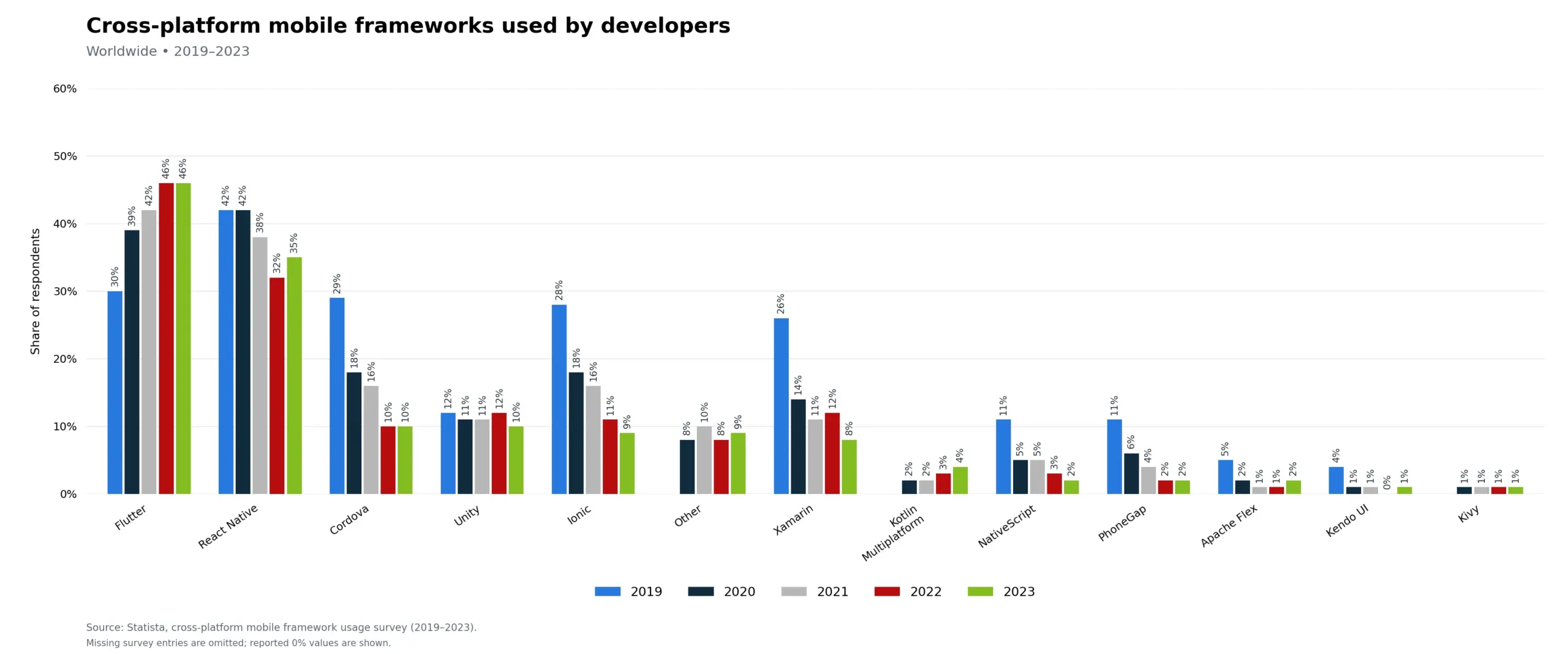
Flutter’s use increased in the cross-platform mobile framework surveys reported by Statista. In 2019, 30% of respondents reported using Flutter, compared with 42% for React Native. Flutter moved ahead in 2021, reaching 42% while React Native stood at 38%. By 2023, the figures were 46% and 35%, respectively. These historical survey results measure framework usage rather than current market share.
The chart below shows framework usage from 2019 to 2023.
Cross-platform mobile frameworks used by software developers worldwide from 2019 to 2023
Other adoption indicators measure different aspects of Flutter’s ecosystem. According to the official Flutter FAQ, more than one million apps had shipped using Flutter by May 2023. In December 2024, the Flutter team reported more than one million monthly active developers worldwide.
The same December 2024 announcement cited Apptopia data showing that Flutter usage among tracked free apps in Apple’s App Store had grown from around 10% in 2021 to nearly 30% in 2024. This measure concerns tracked free iOS apps, rather than all mobile apps or only newly released applications.
Adoption figures do not make Flutter the right choice for every product. The decision between Flutter and React Native still depends on the required architecture, performance, native integrations, team expertise, and development budget. Those requirements should guide planning across the software development life cycle, including testing and long-term maintenance.
Sector-wise adoption of Flutter
| Sector | Flutter Adoption |
| Healthcare | The healthcare sector uses Flutter to enhance patient engagement through telemedicine apps, manage medical records, and provide easy access to health information. |
| Finance | Financial institutions use Flutter to create secure and user-friendly mobile banking apps, investment platforms, and payment gateways, streamlining financial services. |
| E-commerce | E-commerce entities utilize Flutter for visually appealing, feature-rich shopping apps with smooth navigation, real-time inventory updates, and personalized shopping experiences. |
| Entertainment | Flutter drives engaging user experiences in the entertainment sector, powering streaming platforms, gaming apps, and media-sharing applications. |
| Tech and cloud services | AWS Amplify simplifies the integration of AWS services into Flutter applications across multiple platforms. Amazon’s support signifies the tech sector’s inclination toward Flutter for developing multi-platform apps. |
| Animation and design | Rive demonstrates the framework’s influence in the design industry by reshape the way developers integrate animations into Flutter apps. |
| Back-end development | Serverpod, a scalable app server built with Dart, and tools like Dart Frog indicate the extension of Flutter into back-end development, enriching the ecosystem further. |
| Retail and food services | The retail and food service industries are best represented by Wolt, whose Flutter-built app allows orders and deliveries in many countries. |
Each sector use Flutter’s capabilities to address unique challenges, demonstrating its versatility and efficacy in enhancing operational efficiencies and user experiences.
Factors behind Flutter’s adoption
Flutter’s adoption reflects several practical advantages: shared code across platforms, control over interface design, and an established ecosystem of tools and packages. For businesses, these capabilities can reduce duplicated development work and simplify product maintenance. The benefits depend on the application’s requirements, the quality of its implementation, and the team’s experience.
Performance advancements
Flutter uses Dart, which supports ahead-of-time (AOT) compilation to native machine code for production applications on supported mobile and desktop platforms. As explained in the Dart overview, the language supports both development workflows and compiled application deployment. AOT compilation provides a foundation for runtime performance, while actual response times depend on application code, data processing, and device capabilities.
Dart’s sound null safety helps developers detect unsafe uses of potentially null values before deployment. It reduces a class of programming errors, but does not eliminate every runtime exception or replace testing. Its main value for a development team is more explicit handling of nullable data and earlier feedback from analysis tools.
Flutter’s rendering approach has also evolved. According to the official Impeller documentation, Impeller is the default rendering engine on iOS and Android API 29 or later. It prepares shaders ahead of time to reduce runtime shader compilation and make rendering performance more predictable. Flutter on the web continues to use Skia-based rendering.
Flutter’s widget system gives developers control over interface composition, but complex screens and animations still require careful implementation. Teams should use performance profiling tools and test on representative devices to identify expensive rebuilds, rendering delays, and memory issues. For businesses, measured performance under realistic conditions is more useful than a framework-level promise of speed.
Community and support ecosystem
Flutter’s ecosystem gives teams access to documentation, reusable packages, development tools, and community support. These resources can help with onboarding and implementation, while package selection and maintenance remain the responsibility of the project team.
- Documentation and development tools. The official Flutter documentation covers setup, interface development, testing, accessibility, and deployment. Flutter DevTools supports debugging and performance analysis.
- Packages and plugins. The ecosystem on pub.dev includes packages for device features, networking, authentication, and other common requirements. Teams should review platform support, licensing, release history, and unresolved issues before adopting a dependency.
- Community support. GitHub discussions, Stack Overflow, and channels listed on the official community page provide opportunities to exchange knowledge and discuss implementation problems.
- Releases and maintenance. Flutter’s release notes document new capabilities, fixes, and compatibility changes. Teams need to plan upgrades and validate their applications and dependencies after updates.
- Events and meetups. Community events and the Flutter Meetup Network offer opportunities to learn from other teams and share production experience.
- Open-source contribution. Developers can report reproducible issues, contribute fixes, and improve documentation. Commercial support is also available through agencies and consultants listed in Flutter’s support resources.
For a business evaluating Flutter, the ecosystem’s value lies in how well it supports the intended product. Maintained dependencies, relevant expertise, and a clear upgrade plan help turn the framework’s capabilities into a sustainable application.

Spotlight on emerging Flutter development paradigms
Focusing on new development paradigms, Flutter is guiding the mobile app development space toward more efficiency, inclusivity, and innovation as it moves through 2024. These paradigms demonstrate how flexible and forward-thinking Flutter is in meeting the changing needs of the user experience and technology.
Widget-based development
One of the main characteristics of Flutter’s design approach is its widget-centric architecture. The fundamental components of an application are its widgets, which encompass its user interface and behavior. This innovative method encourages a declarative, more intuitive programming style by streamlining the development process.
Everything is a widget in Flutter, including the decorative components like fonts and colors and the structural components like buttons and menus. This consistency makes it easier to create a smooth, hierarchical design that allows widgets to be stacked inside one another, creating a highly modular and reusable codebase.
The widget-based paradigm further supports reactive programming. Performance is maximized since only the impacted widgets are rebuilt when a widget’s state changes. This is incredibly helpful when developing dynamic, responsive user interfaces that fluidly adjust to various screen sizes and platforms.
Flutter’s paradigm streamlines development and debugging, freeing developers to concentrate more on crafting captivating user experiences.
Cross-platform innovation
Flutter excels at cross-platform innovation since it keeps breaking down boundaries in developing desktop, web, and mobile applications. Using a single codebase, developers can now produce high-caliber programs for Windows, MacOS, Linux, iOS, Android, and the web. By doing this, you may drastically reduce development time, resource consumption, and the possibility of issues arising from managing several codebases.
Flutter’s near-native performance on all platforms is one of the notable improvements; this has always been a problem with cross-platform frameworks. Its Skia graphics engine, which guarantees quick rendering and permits uniform behavior across platforms, enables this.
Additionally, Flutter makes it easier to create UI versions tailored to numerous platforms, enabling developers to follow each platform’s unique design specifications without compromising on a single codebase. This degree of adaptability is essential for giving the apps a native feel and raising user happiness.
Furthermore, Flutter’s extensive widget library and its smooth integration of platform-specific APIs improve its capacity for cross-platform innovation. Its effectiveness in cross-platform development is highlighted by how simple it is for developers to access and make use of the native features and services of the underlying platforms, all without sacrificing speed or user experience.
As a catalyst for creative solutions in the app development ecosystem of 2024, Flutter’s commitment to changing with technology and its community’s enthusiastic involvement in pushing the envelope in cross-platform development make it an ideal choice.
Anticipating Flutter’s evolutionary curve ahead
As Flutter’s trajectory rises, looking ahead on its developmental curve reveals promising opportunities, sometimes even related to SaaS platform development. Conceptually, the development field is expected to be further raised by the plan, which seems full of possibilities. This section explores the exciting future directions of Flutter, including new features, versions, and the growing ecosystem ahead.
Upcoming versions and features
The horizon of Flutter’s developmental roadmap is adorned with promising versions and features to raise the framework’s efficacy and developer experience.
Enhanced null safety and error handling. Continued improvements in these areas are crucial for building reliable apps, minimizing runtime errors, and simplifying debugging.
Sophisticated state management solutions. Upcoming versions are anticipated to bring more advanced state management solutions, simplifying the development process and enhancing app performance.
Advancements in Dart. With Dart being Flutter’s underlying language, its advancements are set to bolster performance and ease of development significantly.
Improved web support. Targeting better performance and smaller code size, advancements in Flutter’s web support are on the horizon, promising an enhanced development experience.
Streamlined tooling and integration. Better integration with existing development environments and improved tooling is expected to streamline the development workflow, boosting productivity.
Expanded widget library and plugin ecosystem. The continuous expansion of Flutter’s widget library and plugin ecosystem will provide developers with a broader array of tools and functionalities, enabling more complex, feature-rich applications.
These enhancements in upcoming versions aim to propel Flutter further as a versatile, developer-friendly framework for cross-platform app development.
Taking advantage of Flutter with Program-Ace
Building well in Flutter takes an experienced partner. Program-Ace is a custom software development company that has shipped software since 1992 across 900+ projects. We pair that delivery experience with Flutter’s speed to build reliable cross-platform apps around your product vision.
It’s exciting to see where Flutter is going, and with Program-Ace, you can make the most of it. Go beyond the norm and contact us to start a joint journey towards developing amazing, advanced Flutter apps.