

The virtual reality, sometimes also called “immersive reality,” has been associated only with the gaming industry for quite a long period of time.
Well, the gaming side is cool, while VR helps players to fully immerse into an exciting computer-generated world. But today, I see this emerging technology is about to change this popular notion. It is fascinating to see how virtual, as well as augmented reality, is taking on new markets and how major industries see their share of transformation because of VR. The numbers are striking: around 171 million people use VR worldwide in 2025, up more than 60% in two years, and demand is shifting from consumer entertainment to enterprise training and productivity.
Here are our insights into VR market statistics and what industries have already started to take advantage of Virtual Reality, where the VR market is now, where it is going, and the experts’ prediction for VR growth in the upcoming years.
Education
Education is the first sector that comes to mind when thinking of a non-gaming use for VR.
It brings truly endless opportunities to both students and teachers and can make a shift in the education process. Almost any field starting from the science lessons to the exploration of human anatomy can benefit from the VR technology. VR can enable a kind of applications that bring the education process to the next level. Just imagine students who step into a time capsule with the help of high-quality VR devices and are fully immersed in the atmosphere of the past during a history lesson. And what if students could do a “space walk” or interact with the atomic model while sitting in a classroom? It would definitely spike the interest and understanding of certain subjects. Actually, I believe that the use of VR devices wouldn’t surprise anyone in the near future and will soon become an integral part of the teaching process.
Training
While education is a huge sector that offers enormous opportunities for VR, this technology is still in its infancy at the market.
The same can’t be said for the training sector. According to statistics, VR solutions have been in use to train practical skills for quite a long period of time.
Many businesses have been taking advantage of VR technology to provide a more life-like experience to trainees in comparison with traditional training programs.
VR is often used as a part of supplemental trainings and readiness programs to cut down on expenses for real-time trainings and/or reduce the risk of injury.
As an example,
- VR training programs for firefighters are widely used and have shown high efficiency for trainees;
- Surgical training provides a realistic education to less experienced doctors and reduces the risk to patients;
- NASA has been using virtual reality to train astronauts for years. This allows realistic trainings in an accurate, simulated environment;
- Skills trainings in VR allows one to practice a certain skill like welding in a realistic environment without wasting resources and money.
Healthcare
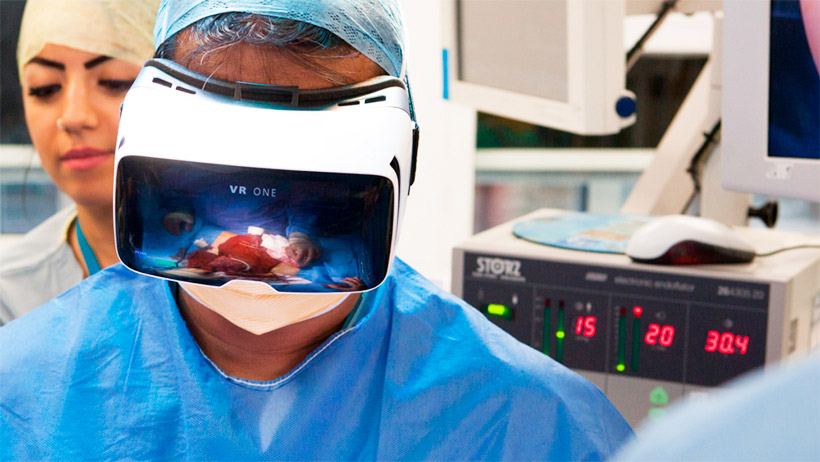
Along with virtual trainings for doctors that help reduce the hours of observation trainings and raise their effectiveness, virtual reality solutions can be used by patients to treat many problems. With a VR headset on, patients learn to cope with their fears, e.g. fear of flying, heights, crowds, or even spiders. Public speaking training programs in virtual reality that help someone overcome stage fright are also very effective. Today, these programs are used in professional institutions, but I hope to see self-treatment VR applications soon that can be used with mobile devices and most popular VR headsets like Oculus Rift and HTC Vive for these health issues.
Automotive
The possibilities of VR in this industry can be best illustrated by Ford and its technologically-advanced designing. The Ford team uses its VR Lab not only to work on the concepts of new cars but also to create autonomous vehicle technologies.
Moreover, its FordVR app allows one to experience extraordinary off-road races, see automotive superstars in action, and go behind the scenes on a mobile device with or without a VR headset. This is a smart way to promote and raise interest in the brand.
Marketing and advertising
Many world-famous companies use VR to create brand-new and persuasive marketing materials.
Along with Ford, one more automotive giant, the manufacturer of luxury vehicles – Jaguar – took advantage of this breathtaking technology to introduce the upcoming electric car – the I-PACE Concept – through the world’s first VR reveal. With the help of a VR brochure, users can examine the interior and exterior of the car, see how different elements function, and get an unforgettable look and feel of the newly-announced vehicle.
VR will definitely enrich event marketing and trade shows.
Rather than wasting thousands of dollars on building huge stages and moving equipment, smart companies are investing in virtual reality applications that are eye-catching, immersive, reusable, and cost-effective. Advertisers also take advantage of VR technology by creating promo reels or mini-games, such as Feel Wimbledon from Jaguar UK, Santa’s Sleigh Ride VR from Coca-Cola, and Mirinda VR.
The trend of using VR devices for advertising and marketing will definitely grow stronger in the coming years.
VR statistics and forecasts
Today, VR is one of the most trendy technologies.
Many statistics portals, as well as industry-specific platforms, are gathering information and making forecasts to better develop the strategy for tomorrow’s world and prove that the VR market will grow dramatically beyond its current size in the near future. Let’s check some of the research that demonstrates the current state of the VR market and the forecasts for the next five years.
One of the world’s largest platforms where users can publish and share 3D content, Sketchfab, published a report showing the results of their recent VR survey.
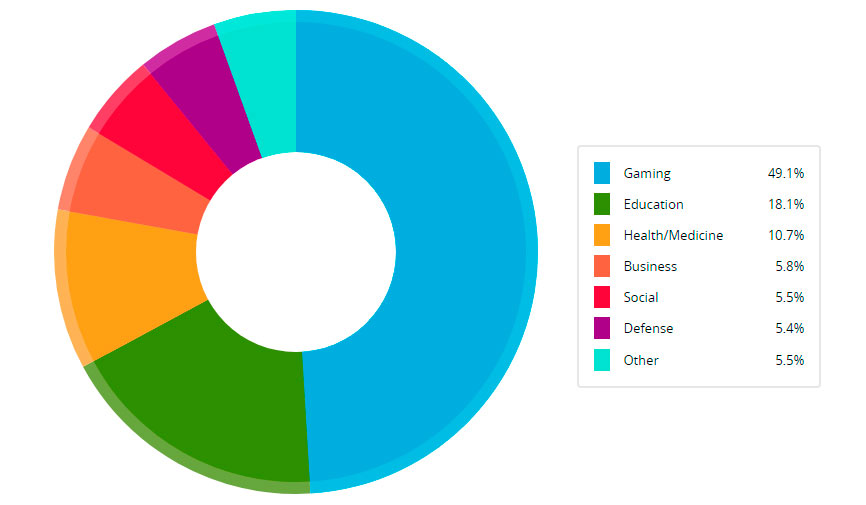
More than 1,600 Sketchfab contributors have shared their vision of the future of virtual and augmented reality, answered questions related to VR hardware, and expressed their opinion about how the VR market will change in the next couple of years. According to this trend report, the majority of community members (49.1%) believe that gaming will remain the largest industry for VR. Education follows the gaming sector with 18.1% of the responses. Healthcare and medicine are ranked third with 10.7%. Business, social, and defense are also on the list of the most anticipated industries for VR in 2017.
Another industry study that is worth mentioning was conducted by Statista, one of the leading statistics portals. According to the high adoption scenario, both virtual and augmented reality are forecast to amount up to $29.5 billion in 2020 compared to $7.1 billion in 2017.
The same growth is forecast by the research driven by SuperData’s VR Data Network. According to this report, the VR market will cost up to $28.3 billion in 2020.
It is still hard to say how big the non-gaming VR market is today, but the forecasts made by experts are very encouraging, and there is tremendous interest in VR from the business community:
- Almost 75% of the world’s valuable brands are taking advantage of industry-specific VR apps to increase customer satisfaction or improve employees’ performance, according to Forbes.
- Tech giants including Facebook and Microsoft are investing millions of dollars into this field, which means the breakthrough in VR, resulting in a massive use of serious Virtual Reality applications, is not far off.
The use of VR content across multiple industries is expected to become a normal state of things soon.